
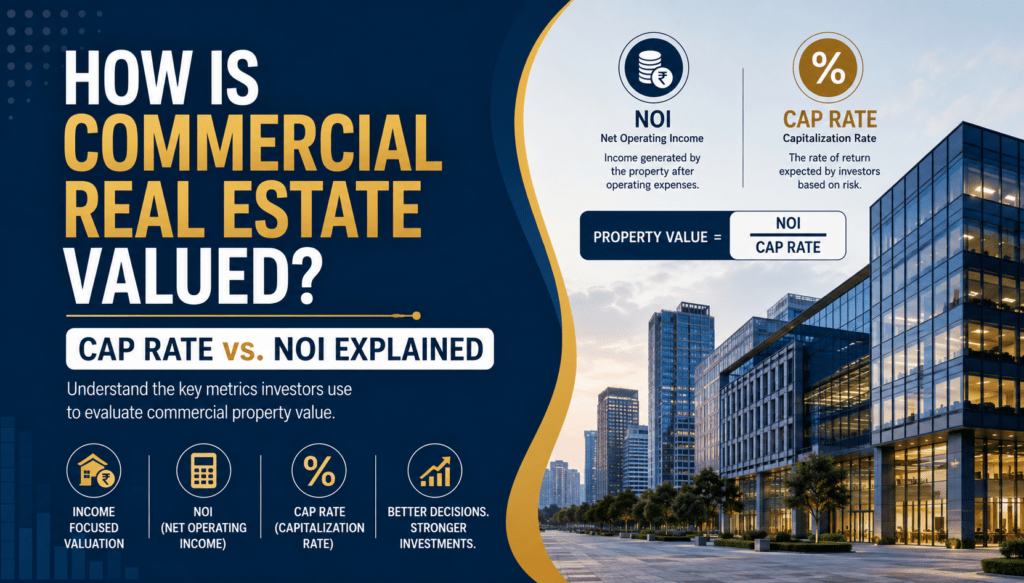
Commercial real estate is primarily valued by its ability to generate income rather than by comparable sales alone. Investors typically calculate a property’s Net Operating Income (NOI) and divide it by the capitalization rate (cap rate) to estimate its market value. A higher NOI generally increases value, while a higher cap rate generally lowers it because it reflects greater perceived investment risk.
What Is Commercial Real Estate Valuation?
Commercial real estate valuation is the process of estimating the market value of an income-producing property such as an office building, retail shop, warehouse, business park, or mixed-use development. Unlike residential real estate, where comparable home sales often dominate pricing, commercial properties are evaluated primarily based on their income potential.
The three most common valuation approaches include:
- Income Approach
- Sales Comparison Approach
- Cost Approach
Among these, the Income Approach is considered the industry standard for stabilized commercial assets because investors purchase these properties for their expected cash flow rather than personal occupancy.
Fact: According to the Appraisal Institute, the Income Capitalization Approach is the preferred valuation method for most leased commercial properties because it reflects investment performance rather than replacement cost.
What Is Net Operating Income (NOI)?
Net Operating Income (NOI) represents the annual income generated by a commercial property after subtracting operating expenses but before accounting for financing costs, taxes, depreciation, and capital expenditures. It measures how efficiently a property generates income from operations.
The basic formula is:
NOI = Gross Operating Income − Operating Expenses
Gross operating income typically includes:
- Rental income
- Parking fees
- Maintenance reimbursements
- Advertising revenue
- Other recurring property income
Operating expenses generally include:
- Property management
- Insurance
- Maintenance
- Utilities (where landlord-paid)
- Property taxes
- Security
- Cleaning
Expenses that are not included in NOI include:
- Mortgage payments
- Income tax
- Depreciation
- Capital improvements
Example
Annual rental income: ₹1,20,00,000
Operating expenses: ₹30,00,000
NOI = ₹90,00,000
This figure becomes the foundation for estimating investment value.
Fact: Commercial operating expenses commonly range between 25% and 45% of gross operating income, depending on property type and lease structure.
What Is a Cap Rate?
A capitalization rate, commonly called a cap rate, measures the expected annual return on a commercial property based on its current market value. Investors use cap rates to compare properties across different markets and asset classes.
The formula is:
Cap Rate = NOI ÷ Property Value
For example:
NOI = ₹90,00,000
Property Value = ₹15,00,00,000
Cap Rate = 6%
Lower cap rates usually indicate lower perceived investment risk or stronger market demand, while higher cap rates generally indicate higher risk or slower market appreciation expectations.
Cap rates vary according to:
- Property location
- Asset quality
- Tenant strength
- Lease duration
- Market demand
- Interest rates
Fact: Institutional-grade office and retail assets in established business districts often trade within a narrower cap rate range than secondary-market properties.
How Are NOI and Cap Rate Used Together to Value a Property?
Commercial property valuation often follows a simple mathematical relationship:
Property Value = NOI ÷ Cap Rate
Consider the following example.
Annual NOI = ₹1,00,00,000
Market Cap Rate = 8%
Property Value:
₹1,00,00,000 ÷ 0.08 = ₹12,50,00,000
Now assume the property’s NOI increases to ₹1,20,00,000 while the cap rate remains unchanged.
New Value:
₹1,20,00,000 ÷ 0.08 = ₹15,00,00,000
Conversely, if interest rates rise and investors require a 9% cap rate instead of 8%, the same NOI would produce a lower valuation.
This relationship explains why commercial property values are influenced by both operational performance and market conditions.
Fact: Rising interest rates frequently place upward pressure on cap rates, which can reduce commercial property values even when rental income remains stable.
What Is the Difference Between NOI and Cap Rate?
Although these terms are closely connected, they measure different aspects of a property’s investment performance.
| Metric | Net Operating Income (NOI) | Cap Rate |
|---|---|---|
| Measures | Property income | Expected investment return |
| Expressed As | Currency (₹) | Percentage (%) |
| Purpose | Measures operational profitability | Estimates market value and risk |
| Changes When | Income or expenses change | Market expectations change |
| Used By | Owners, lenders, investors | Investors, appraisers, analysts |
NOI evaluates property performance, while the cap rate reflects market pricing and investor expectations. Both are required to estimate fair market value using the income approach.
Why Do Cap Rates Differ Between Properties?
Cap rates are not fixed percentages. They change based on the risk profile of both the property and its surrounding market.
Several factors influence cap rates:
- Location quality
- Occupancy levels
- Tenant creditworthiness
- Remaining lease term
- Property age
- Local supply and demand
- Financing environment
- Economic outlook
For example, a fully leased Grade A office building with long-term corporate tenants may command a lower cap rate than a partially vacant retail property with short-term leases.
In markets such as Greater Noida, Greater Noida West, and Noida Extension, investors also evaluate infrastructure development, metro connectivity, commercial absorption, and future business demand before determining acceptable cap rates. Professionals at Hive Group, who work with commercial leasing across these micro-markets, often observe that occupancy stability and tenant quality have a measurable influence on investor pricing alongside broader market trends.
Fact: Vacancy rates remain one of the strongest indicators affecting commercial asset pricing because declining occupancy directly reduces NOI.
Can Two Properties With the Same NOI Have Different Values?
Yes. Two commercial properties can generate identical annual income but still have significantly different market values because investors assign different cap rates based on perceived risk.
Example:
| Property | NOI | Cap Rate | Estimated Value |
| Property A | ₹1 crore | 6% | ₹16.67 crore |
| Property B | ₹1 crore | 8% | ₹12.50 crore |
Although both properties produce the same income, the lower cap rate assigned to Property A results in a substantially higher valuation.
This difference often reflects factors such as tenant quality, lease duration, property condition, or location rather than income alone.
Fact: Even a one-percentage-point change in cap rate can significantly alter valuation, particularly for high-value commercial assets.
Is Cap Rate the Only Way to Value Commercial Property?
No. While the income capitalization method is widely used, professional appraisers often combine multiple valuation approaches.
These include:
- Income Capitalization Approach
- Discounted Cash Flow (DCF) Analysis
- Sales Comparison Approach
- Cost Approach
The DCF method estimates future cash flows over several years and discounts them to present value. It is commonly used for large commercial developments, mixed-use projects, and assets with changing lease structures.
The Sales Comparison Approach compares recent transactions involving similar properties, while the Cost Approach estimates replacement cost after accounting for depreciation.
Professional valuations often reconcile results from multiple methods rather than relying on a single calculation.
Fact: International valuation standards recommend selecting valuation methods based on property type, available market evidence, and intended use of the appraisal.
How Can Investors Apply NOI and Cap Rate in Greater Noida?
Investors evaluating commercial offices, retail spaces, and mixed-use developments in Greater Noida and Noida Extension frequently compare projected NOI against prevailing market cap rates before making acquisition decisions.
A property with strong occupancy but unusually high operating expenses may generate a weaker NOI than expected. Similarly, a building with modest current income but long-term leasing potential may justify future value growth if rental income increases over time.
Local transaction evidence, rental trends, vacancy levels, and infrastructure development should always accompany NOI and cap rate analysis. Firms such as Hive Group typically analyze these variables alongside leasing performance to understand pricing across commercial projects in Greater Noida, Greater Noida West, and Noida Extension.
Fact: Investors commonly compare historical rent growth, occupancy trends, and transaction volumes before determining whether a property’s asking price aligns with prevailing market conditions.
Frequently Asked Questions
Does a higher NOI always mean a higher property value?
Usually yes, provided the market cap rate remains unchanged. An increase in NOI generally increases value under the income capitalization approach.
Is a lower cap rate better?
A lower cap rate often reflects lower perceived investment risk and stronger market demand, but it also means investors receive a lower initial yield.
Can cap rates change over time?
Yes. Cap rates respond to interest rates, economic conditions, investor sentiment, vacancy levels, and local market performance.
Do lenders use NOI when approving commercial loans?
Yes. Most commercial lenders evaluate NOI to calculate debt service coverage ratios and determine whether the property’s income can support loan payments.
Which matters more: NOI or cap rate?
Both are essential. NOI measures operational performance, while the cap rate reflects market pricing. Commercial valuation requires both metrics.
Contact Details for more info :
Hive Group
+91 7905612853
A 333, Grandthum
Table of Contents
Cap Rate Explained Net Operating Income (NOI) Commercial Property Valuation Commercial Real Estate Investment How to Value Commercial Property Cap Rate Formula NOI Formula Commercial Property Investment India Greater Noida Commercial Property Commercial Real Estate Metrics